
Building History: The Tribe Builds Historic Campus With Lego Bricks
CLARE PACELLA // FLAT HAT MAGAZINE
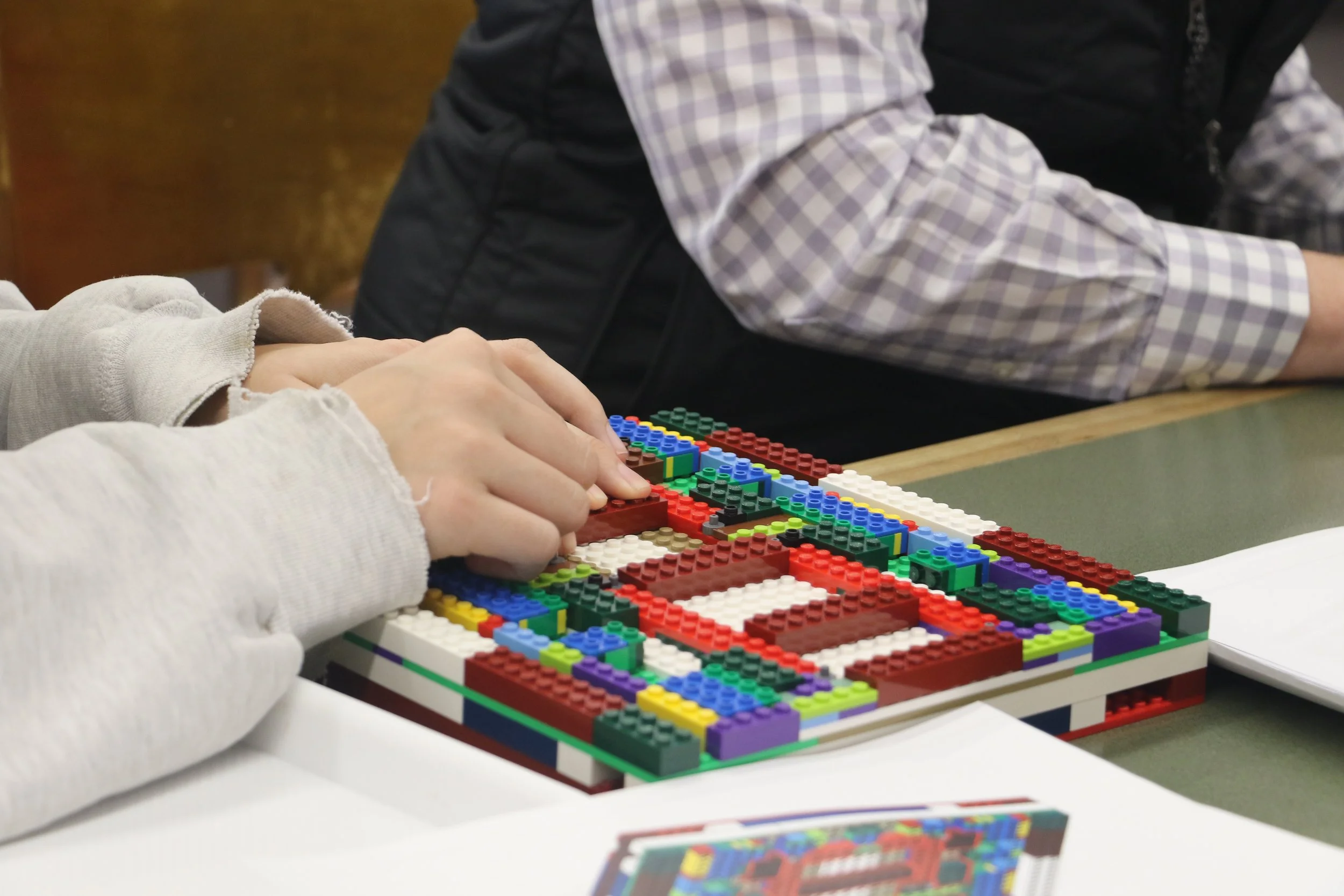
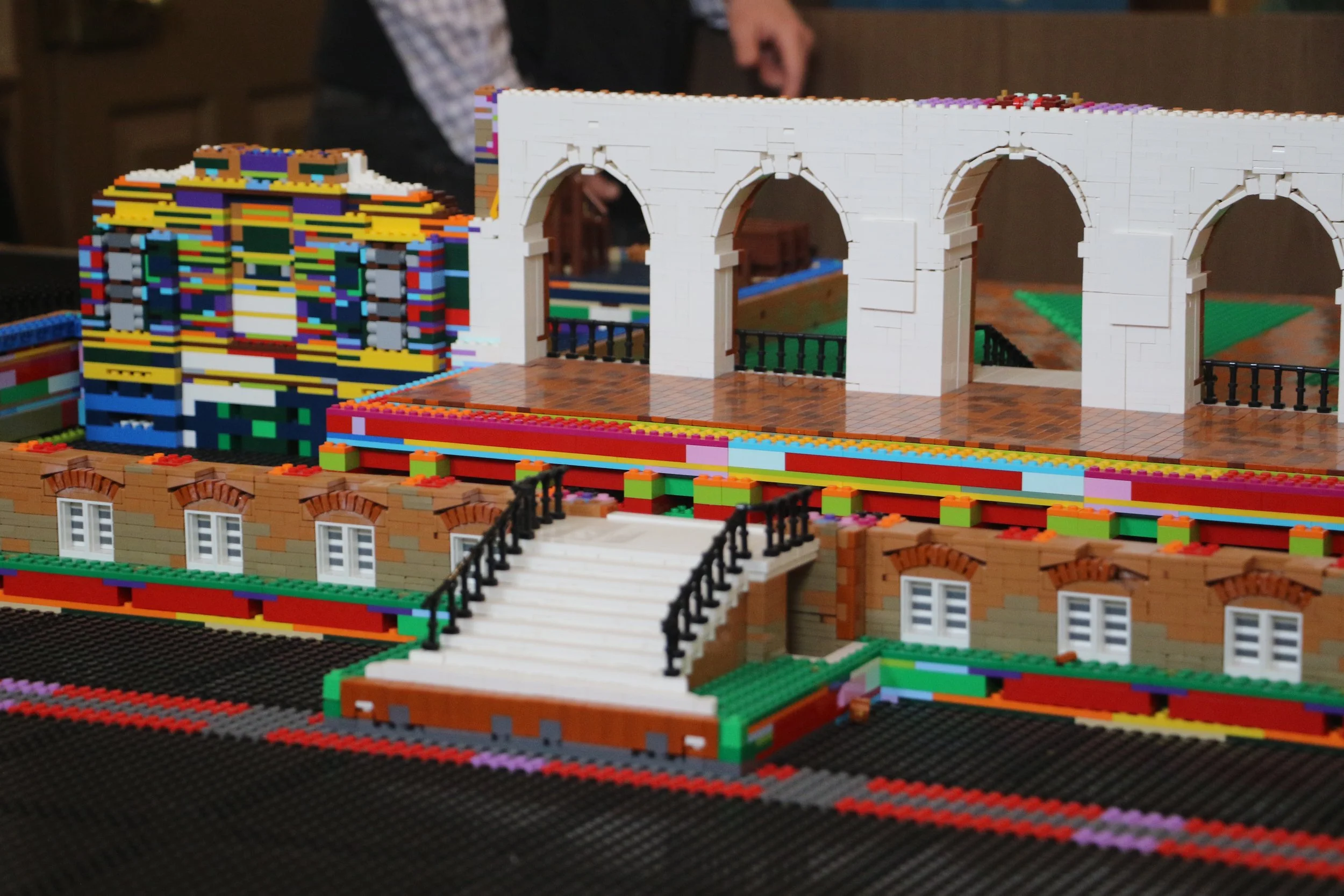
Using 230,000 Lego bricks, members of the Tribe construct at 64-square-foot model of historic campus, featuring the Sir Christopher Wren Building, the President’s House, and the Brafferton Building. Clare Pacella ’28 talks with Director of Wren Operations and Events Charles Fulcher ’99 about the project.
One February night, Malaya Garza ’28 sat on the Lego-brick-covered floor of her dorm room. The Lego Mineral Collection box stood in the center as Garza assembled the amethyst. Next to the piece count on the bottom of the sleek, black box stood a surprising age rating: 18 and up. Not 14, not even 16, but 18.
The current Lego bricks launched in 1958, and the Lego Group is still going strong in 2026. But gone are the days of bright yellow boxes and Lego City sets. In recent years, the company has been targeting a new audience: adults. Using an appeal to nostalgia, Lego has successfully produced many lines of 18-and-up sets that span a range of interests, from Star Wars to Pokémon to the botanical series.
The College of William and Mary is not immune to this phenomenon of sensational Lego sentimentality. Beginning in 2025, the College’s community joined together to complete an enormous project: a 64-square-foot model of historic campus — built out of about 235,000 Lego bricks. Funded by Bruce Christian ’73, the model will feature the Sir Christopher Wren Building, the President’s House, and the Brafferton Building.
Director of Wren Operations and Events Charles Fulcher ’99 facilitates the project.
To plan and execute the massive model, Fulcher works closely with Sensational Bricks Limited — a firm in the United Kingdom specializing in large-scale Lego construction — and the model’s designer, Romão Santos. Fulcher explained the process of the materials’ journey from Europe to the College.
After Santos does the design work, Sensational Bricks Limited assesses the pieces it has in stock and what the build requires. The company then collects and packages the necessary materials before shipping them overseas to the College. The pieces arrive in bulk, leaving Fulcher and volunteers to transform bags of chaos into organized sets of each block type. Fulcher receives the instruction manuals as PDFs, which he then downloads and prints.
Upon receiving each shipment of materials, Fulcher and a team of volunteers spread them across the tables in the Wren Building’s Great Hall before counting and sorting the bricks into individual module kits. The project is made up of these modules, which are then put together to create the final product. Once the modules are prepared, they are ready to be built by students, faculty, alumni, and community members through facilitated builds in the Earl Gregg Swem Library or at events such as Women’s Weekend, Family Weekend, and Homecoming Weekend.
“What we're basically doing is making a kit, just like you would buy Lego off the shelf at a store. You've got bags and parts and instructions. We do that,” Fulcher said. “We just will make several hundred of those over the course of this model.”
Though the build was intended to be completed by July 2026, the time-consuming nature of sorting thousands of pieces has delayed this projection.
“At the rate we're currently going, it will take several years,” Fulcher said. “This is speculation. I don't know, but [we hope to be] finding opportunities to distribute more of these so that everybody can keep building going, because then you've got simultaneous building, and we can make a lot more progress. So, could be a couple more years, but I’d like to pick up the pace.”
Fulcher has three main goals for the project. One aim of the project is that the completed model will serve as an educational tool to be used in the welcome center of the Wren Building. When the model is finished, the roofs of the Great Hall and the Chapel will be removable to allow visitors to view the inside details, such as a winding staircase, rows of pews, and paintings of former U.S. presidents. So far, the model has become especially helpful when helping visitors visualize the Wren Building underneath its current curtain of construction and renovations. For example, while the piazza falls beneath a veil, the model allows visitors to see what the area typically looks like. Additionally, the model makes it easier for guests to understand the whole of the building, and it provides an easy way to display the building’s originally planned quadrangle structure.
CLARE PACELLA // FLAT HAT MAGAZINE
The second aim is to become an incentive for people — whether it be current students, prospective families, or tourists — to visit the Wren Building; the model serves as another way to engage the public in the College’s history. Lastly, the construction process creates a meeting point for all members of the Tribe to come together and create something.
“Building bridges, making connections, really means a lot to me, and all the goals of this project fall in line with that,” Fulcher said. “It's using this model as an educational tool. It's surprising people, and I think sometimes when you can surprise people out in their expectations, they might be open to seeing the whole site in a new way. It's really important to me that the Wren is not just an antique tucked behind glass; it's an active, living, breathing part of our community.
As the Tribe comes together, snapping bricks into place as it builds history from the ground up, people share stories, memories, and a love for Lego, no matter the age. Builders and sorters reminisce about playing with Lego as a child, or playing with Lego with their own children. Some express an ongoing love for Lego in their adult lives.
“There’s this current interest; it feels like a Lego renaissance,” Fulcher said. “But I don’t think it’s ever really gone away. It just continues to build and grow.”
In addition to its original lines, The Lego Group continues to release branded and co-licensed products to fill any niche interest, whether it’s Pokémon, Star Wars, Peanuts, or architecture. Fulcher explained how these expansions help to gain the attention of customers outside of the typical Lego fandom, especially adults.
“Some of the lines adults could love to build, and kids could love to build. I mean, everybody can love to build every one of these things,” he said. “But when the box and the packaging design is this slick black, very refined — like the architecture series, amazing buildings — the boxes look grown up. Yeah, clearly marketed towards adults.”
There is another reason for this Lego renaissance, beyond packaging and advertising. Leah Perlman ’28, a Lego fan for as long as she can remember, explained one of the reasons that she still builds with Lego bricks today.
“As a 20-year-old, Lego appeals to me today primarily for the experience of building the set. It scratches an itch in my brain and calms my anxiety in a similar manner to adult coloring books,” Perlman said. “I think that other adults are drawn to Lego for similar reasons to me: the experience of building is a calming escape in an increasingly stressful world.”
Drawing from his experience observing students and staff, Fulcher provided insight into why adults like Garza and Perlman find Lego so appealing even after all of these years. In the adult world, it is very rare to have something so simple as following instructions. When a person sits down to build with Lego bricks, whether it’s a bouquet of flowers or the Wren Building, they create a calm, orderly moment in the midst of a life that can often feel chaotic.
“You get older, you've got kids, you've got jobs, you've got bills. They're all these kinds of things, these pressures, or these push and pull in different parts of our lives,” he said. “But to sit down with Lego and at pieces available for you, and have step 12 that says, ‘Put this piece here’ and then ‘Put this piece here’ and so on. There's something, there's a sense of order. There's structure. You can turn off part of your brain that is maybe flailing in the unknown, and you are presented for a brief period of time with something definite and concrete.”