
The Year of Civic Leadership
LEAH KOHLER // FLAT HAT MAGAZINE
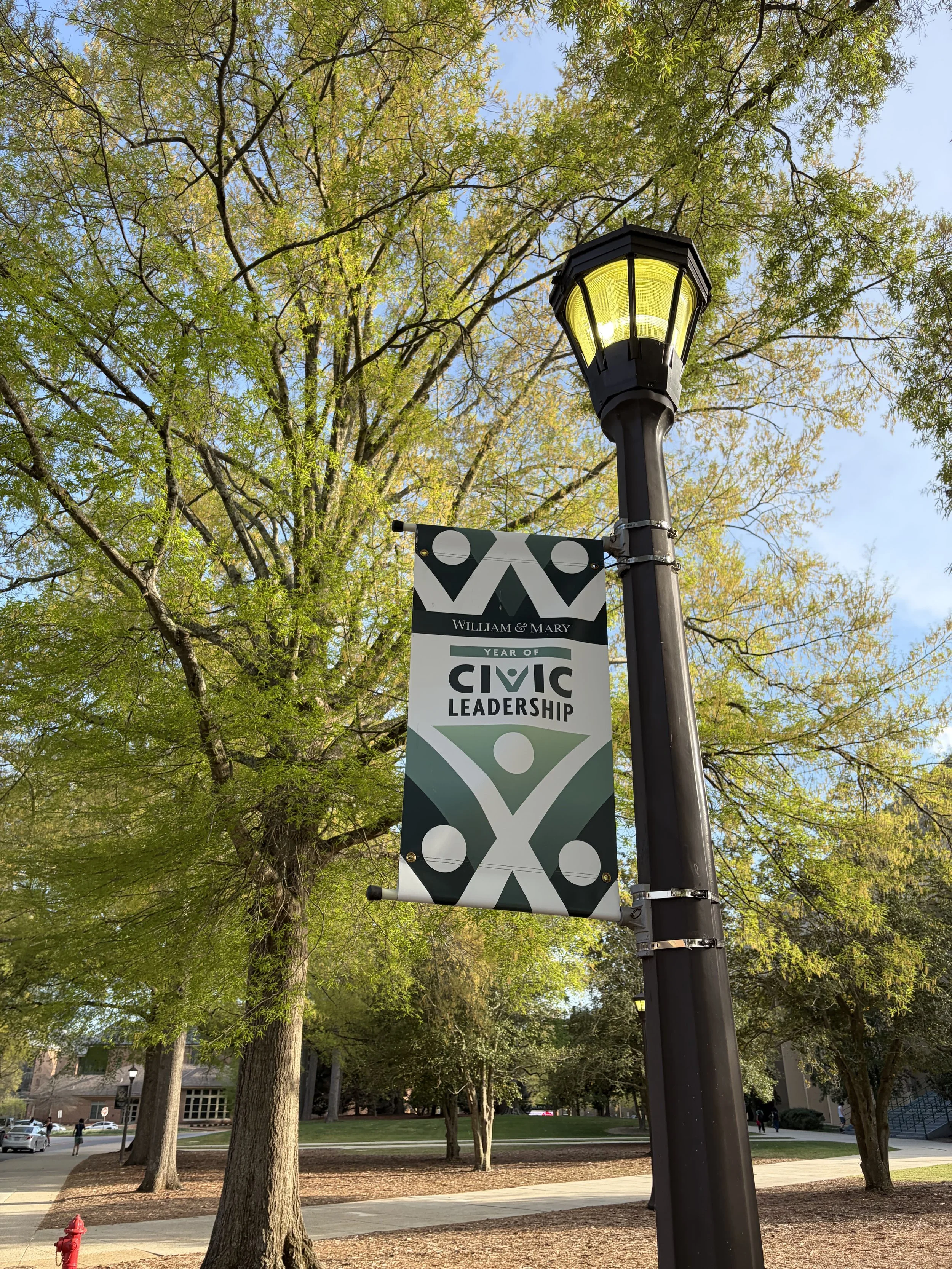
Friday, Feb. 6, 2026, the College of William and Mary celebrated its 333rd Charter Day and officially initiated the Year of Civic Leadership. The designation is especially fitting, given the fact that the United States celebrates the Quarter Millennium this year.
Since its founding in 1693, the College has been central in the development of our country and the education of its leaders. There is no question as to why it is dubbed the Alma Mater of the Nation. However, now more than ever, it is important to recognize what makes a leader and how individuals can get involved in the betterment of society as a whole.
Most often, civic leadership is associated with the students who aspire to work on Capitol Hill or in public offices across the country. While those students certainly are a great example of civic leaders, this year strives to emphasize that direct involvement in government is not a leadership requirement. There are countless individuals pioneering scientific advancements, teaching the next generation, and dedicating their time and efforts to community outreach. They are just as much leaders as those who sign policies into action. On the broadest scale, civic leadership is working to make a difference that goes beyond oneself. In her Charter Day address, Gov. Abigail Spanberger stated that “[civic leadership] rests on a simple but powerful conviction that knowledge carries responsibility and that wisdom must be placed in service to the common good, that civic leaders listen across differences, reason with care, and act with integrity.”
Spanberger also addressed the current divisive political climate. She expressed that facing division “takes engaged, informed citizens choosing service to one another over self-interest, everyday Americans choosing community over chaos and division. People, neighbors, community leaders choosing the pursuit of our common good. We all have a role to play in shaping our communities and our collective future.” That responsibility isn’t limited to humanities majors. It is the responsibility of each and every student who has a vision for the future, as it is a goal only attainable through collaboration and community involvement.
Assistant Provost for Leadership and Academic Engagement Roxane Adler Hickey M.Ed. ’02, Ed.D. ’23 is the chair of the committee for the Year of Civic Leadership. The committee is composed of representatives from numerous departments, the student body, and the alumni population to ensure that programming is designed to best suit the needs of all members of the College community. As they work to develop events and resources, they keep a few key questions at the forefront of their minds.
“How can we talk to each other? How can we build community across difference so that it feels like as a university, we are celebrating our commitment to civic leadership, our commitment to dialogue across difference, and our commitment to continuing to educate leaders for all time coming,” Adler Hickey said.
There are many opportunities for students to get involved on campus, in greater Williamsburg, and beyond. These opportunities are highlighted on the College’s website for the Year of Civic Leadership.
One example is the Better Arguments Project, a national initiative that encourages communication and engagement across different groups. In today’s world, where things might not always feel hopeful, it is important to have difficult conversations that illuminate different perspectives and encourage collaboration toward a common good. Many students have already been exposed to the Better Arguments Project via an orientation seminar; however, its central principles are not something that you listen to once and then move on from. Taking these principles and applying them to daily life is what allows for productive conversations that will pave the way for real change.
Furthermore, there are online courses available for all interested students, faculty, and community members. Modern Leadership: Reflections and Tools for the Values-Based Leadership is offered through the Washington Center and the Studio for Teaching and Learning Innovation. Participants can register individually and begin at any point. The goal of the course is to “challenge participants to move beyond the basics of management into a deeper understanding of modern leadership, where wisdom, emotional intelligence, and principled action define success.”
In addition to these highlighted online programs, there is a lot students can learn about leadership through in-person participation in on-campus organizations. With over 475 registered student organizations, there are over 475 opportunities to get involved within the campus and Williamsburg communities. Of those organizations, over 60 are community-service oriented. According to recent data collected by the Princeton Review, 70% of our student body participates in at least one. That places William and Mary within the top 20 colleges for students looking to make a difference. No matter your social class, it is never too late to try something that you are passionate about, to meet a new group of people, and to be a leader.
The College is also ranked as the No. 1 public university in the nation for study abroad participation. Over the last 17 years, the College has received that designation 12 times. Students are dedicated to expanding their knowledge beyond the campus bounds. Through both university-run and third-party programs, students get the opportunity to participate in internships, take classes, and do research that not only interests them, but provides a once-in-a-lifetime chance to see the world from a new perspective.
Even if studying abroad is not feasible, there are other ways to gain a global perspective. On-campus seminars with experts in various fields are a valuable avenue to seeing current events through a different lens. March 6, 2026, less than a week after the initial military strike on Iran, the Global Research Institute hosted “War in Iran: A Panel Discussion with W&M Faculty,” featuring assistant professor of history and international relations Peyman Jafari, assistant professor of government and co-principal investigator of the Arab Elections project Ameni Mehrez, and associate professor of government and Director of NukeLab Jeffrey Kaplow. The largest lecture hall on campus, Integrated Science Center 1221, was packed with students, faculty, and community members who had questions about the topic. That is civic leadership.
Students of the College are not strangers to the multitude of opportunities that are available to them; however, sometimes it is easy to forget that what they are already participating in has future implications. By choosing to put themselves out there and get involved, students are shaping the person and the leader that they are becoming.
The emphasis on civic leadership might be larger this year, but it has always been present, providing the foundation upon which the College was built. Many students chose to attend the College because of this leadership foundation. Adler Hickey, among others, hopes that the Year of Civic Leadership continues to draw students with similar leadership aspirations.
“Our dream for William and Mary is to be known as the place where leaders go, that on the front end, when students apply to the college, they know they’re going to be thinking about leadership and rolling up their sleeves and getting involved in civic leadership,” Adler Hickey said.
This year, students are encouraged to look beyond their comfort zone, to try something new, to get involved in a way they would not have expected to be involved. In his Charter Day address, Ken Burns gave students a piece of advice.
“It could be the look in the eye of a child raised with love. Or in this simple garden you tend,” he said. “But above all, do something that will last and be beautiful.”